
What if data centers aren’t really about AI?

TL;DR: AI accounts for less than half of the load on data centers built since ChatGPT. Why isn’t anyone talking about what the rest is used for?
Last week CNBC reported that Meta is in talks to rent its data centers to Anthropic, which is odd for a company that’s already spent over $100 billion on these giant warehouses of humming chips. But the contrast is instructive. Anthropic is betting almost everything on frontier AI. Meta can train models, rent out GPUs and, if the AI bubble bursts, continue to employ data centers to power an advertising business that already prints them money.
The public story is that we need these data centers to power the AI revolution. “Build now,” warn developers and politicians, “or your city/state/country will be left behind.” But the numbers don’t match the marketing.
The Electric Power Research Institute (EPRI) forecasts that AI will account for only 15 to 25 percent of US data-center electricity use in 2026. Even that understates the problem, because much of today’s capacity predates ChatGPT.
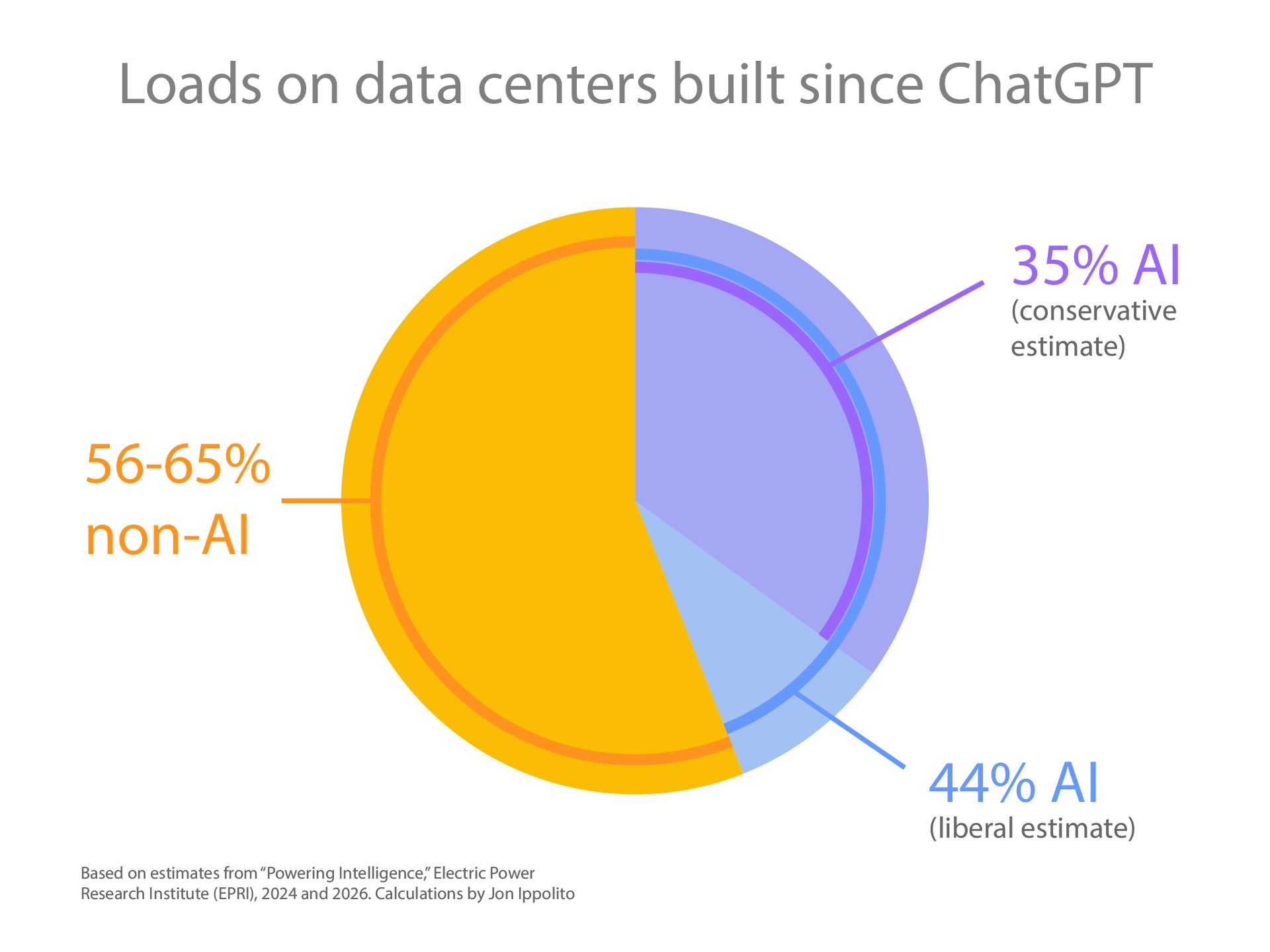
A sharper question is how much of the capacity added during the generative AI boom is actually being used for AI.
The industry estimates US data-center electricity consumption will have risen by about 155 terawatt-hours between the end of 2022 and the end of 2026. EPRI’s high-end projection puts total 2026 consumption at 270 TWh, with AI responsible for 25 percent. Run the numbers and that puts AI’s share of new data center demand since ChatGPT’s debut at about 44 percent. Using a more conservative 20 percent pegs the AI share of new demand at about 35 percent.
Think about that for a second: even under the industry’s rosiest near-term forecast, most of the data-center workload added during the ChatGPT era will not be AI. What’s eating the rest?
Some of it is ordinary cloud storage and streaming video. Some is cryptocurrency. A large share supports advertising, recommendation systems and the continuous collection and processing of behavioral data. When Meta tracks every pause, click and mouse movement made by Patty in Peoria, those petabytes have to get crunched somewhere.
My UMaine colleague Joline Blais calls the current sales pitch for new data centers an “AI Trojan Horse”: a politically attractive justification for infrastructure whose less glamorous uses include surveillance and ad targeting. The public is more likely to tolerate new transmission lines through wildlife corridors and water alerts in the summer if they’re for medical breakthroughs than if they’re for serving Ozempic ads or tracking your period.
The electricity figures I’ve shared here hint that the value proposition for data centers is not what it seems. The financial figures will tell us why the companies are building them anyway. In the upcoming Part 2 of this Substack, I’ll compare what Microsoft, Meta, OpenAI, xAI and the other hyperscalers spend on infrastructure with what they actually earn from AI—and show why the underdiscussed mismatch may be the point.
For all calculations and sources, see my post on this subject at the Still Water blog. Subscribe for more free Edge Condition posts.
Share this post or remix this content via a CC BY-SA 4.0 license.